Serialize and Deserialize
encode and decode
Serialize and Deserialize Binary Tree
Serialize
- 全局变量
String result = ""&int id = 0 - 只要root不是null,每一次call serialwork就
id++,然后把值赋给nowId,即当前树的id - 每个树节点的“4-len“信息包括:val,id,leftid,rightid,用逗号分隔
- 如果树节点为null,id返回-1 (特别是在leaf时,左右子树的id都会时-1)
- 整棵树组成一整个String,组与组用分号
;隔开,四点信息为一组,每组代表一个节点 - 递归得到leftid和rightid,然后写进root的”4-len“信息里 注意: 这个serial function是helper function,修改了全局变量result,但返回int id,所以在主方法中可以随便declare一个rootid去call这个方法,把root node放进去,然后在这个方法执行的过程中result(全局)就被修改了。return result即可。而这个rootId其实在后面也不一定会被用到。
Deserialize
- 将result这整个String分隔成多个String,放在array中。这个方法要用
String[] nodes = result.split(";"),注意split方法返回的是String[] Map<Integer, Treenode>将每一组id和node存进去- 左子树和右子树分别通过map去get出来
- 注意这个方法是bottom up pre-order,所以会先从leaf开始deserialize,等到了parent时,child(leaf with two null children)已经在map里面了,此时要做的是连接起来他们的父子关系
构树
Construct Binary Tree from Preorder-and-inorder/PostOrder-and-inorder
DFSdfs的顺序分为了in/pre/post-order,而bfs只是层级遍历。所以当我们讨论in/pre/post我们指的是dfs。
postorder & inorder / preorder & inorder
- postorder的作用是找到root,每个子树的root
- inorder的作用是划分左右子树
- 比如取出postorder的最后一位元素,它就是原树的root,这个元素再inorder array中的位置,左边皆为左子树,右边皆为右子树。以此类推。
- 用map存好所有的inorder:key:元素;value:index
- 关于index的左右子树的关系(关系到dfs的参数)
具体方法
- edge cases是两个array至少一个为空
- hashmap储存inorder
- dfs返回的是树节点,注意不是void
- dfs,
if (instart > inend || poststart > postend) return null就是leaf的左右子树 - 找到当前树root(即post的最后一个)的inorder index;
- 得到左子树的节点数量
left count = rootindex - instart -
分别dfs左子树和右子树。
- 无论是pre&in/post&in,最好的方法是画一颗普通的树,写出两个遍历,标明index,找出左子树/右子树的index关系。dfs本身的模板是一样的。
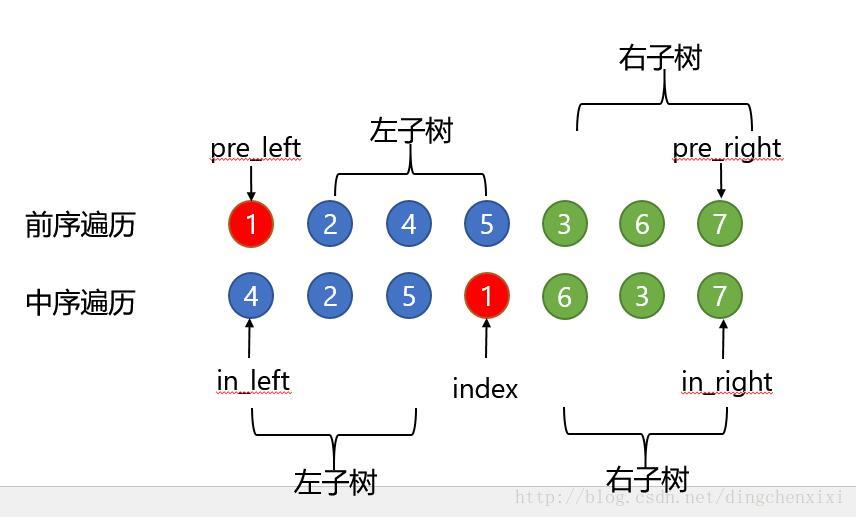
pre-order & post-order
- 道理本质同上,但不完全一样
pre[0]和post[length - 1]是当前数的root.val- 如果本树传进来的节点数
N == 1直接返回root,说明这就一个,是个leaf - 如果大于1,就正常找左右子树的分界,分别递归
- 为了方便可以将pre[]和post[]都变成global 变量
- helper用的param分别为pre_start_index, post_start_index,number_nodes
Construct binary tree from String
- 格式是
"4(2(3)(1))(6(5))"左子树优先,也就是说5是6的左子树,6右子树为null - 用stack方法,preorder的顺序,dfs的思想
- 建立stack
- i遍历整个字符串
- 如果是右括号,pop,这就好比dfs里面的remove(size()-1)
- 如果在0到9之间
else if (char >= '0' && c <='9'), 以这个数字建立新树节点 - 如果当前char是‘-’,说明接下来这个val是个负数,所以要while到数字部分,substring,再
- 如果stack不为空,则peek一下,peek到的就是父节点,如果父节点的左不为null,就将当前节点添加到父节点的right,否则left。
- 最后将当前节点push进去
- 总的最后,在stack不为空也就是root不为null的情况下,stack.peek()返回root
Unique binary search trees
- 给n,从1到n这n个数额能组成多少个不同的BST
- DP
- G(n)=∑ i=1 n G(i−1)⋅G(n−i)
- G(n) is the number of unique BST with n-len sequence, F(i,n) is the number of unique BST when i is the root
public class Solution {
public int numTrees(int n) {
  int[] G = new int[n + 1];
  G[0] = 1;
  G[1] = 1;

  for (int i = 2; i <= n; ++i) {      // G(n)=∑i=1 n F(i,n)
    for (int j = 1; j <= i; ++j) {    // F(i,n)=G(i−1)⋅G(n−i)
      G[i] += G[j - 1] * G[i - j];
    }
  }
  return G[n];
}
}